


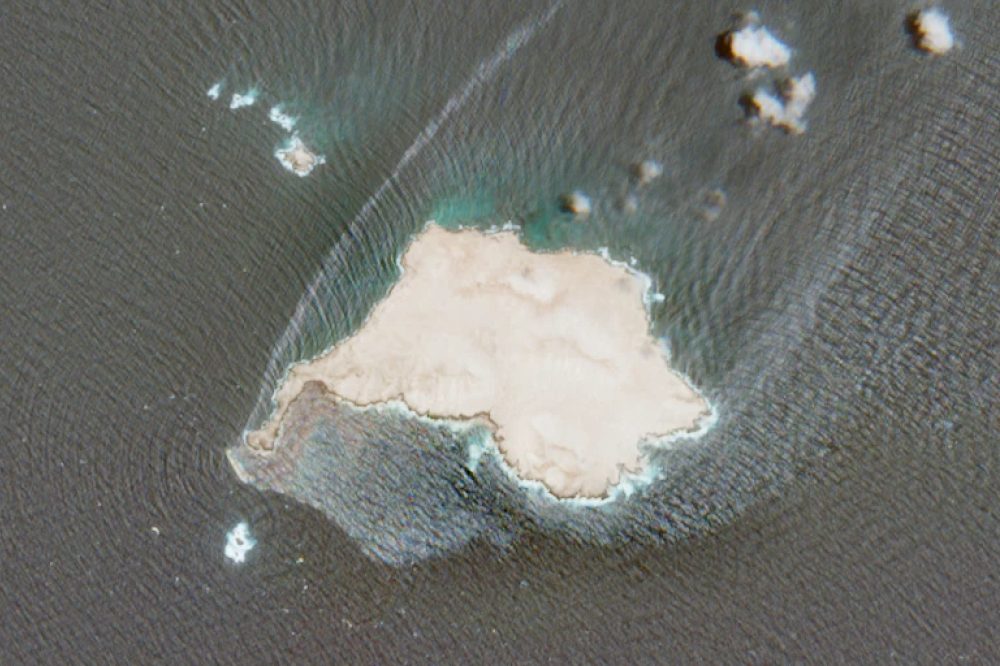
BEIRUT (AP) — An oil spill caused by leakage from a U.K.-sanctioned tanker grounded for weeks off Oman appears to be expanding dramatically, reaching shorelines and far out to sea, according to experts and satellite images reviewed by The Associated Press.
Greenpeace Germany said in a statement Monday that satellite images from a day earlier indicate the oil spill now covers an estimated 150 square kilometers (58 square miles), affecting large stretches of Qibliyah Island off Dhofar, Oman’s largest governorate.
Compared to satellite images from a week earlier, “it is a drastic increase,” said Nina Noelle of Greenpeace Germany, who noted that clearly a large amount of crude oil is leaking. Last week, the spill’s surface area was estimated at 20 square kilometers (8 square miles). It was not clear what has caused the leak to grow.
The images from Sunday showed an oil sheen spreading to the northeast from the 274-meter (899-foot) Suezmax tanker Caroline Bezengi, which is sanctioned by the U.K. for carrying oil that originates from Russia.
The affected area is part of the Arabian Sea reserve, a marine protected area and host to wildlife including endangered petrels and the rare Arabian Sea humpback whale.
Wim Zwijnenburg, an environmental expert for PAX, a Dutch organization that focuses on conflict and the environment, said the sheen is a thin layer of oil that often evaporates depending on the type of crude oil and weather conditions. Thick black patches of oil reached the southern and western shores of the island, he added.
Zwijnenburg said the oil sheen appears to be roughly 90 kilometers long (56 miles), nearly double its length a week ago.
He estimated that the tanker had been carrying over 800,000 barrels of crude oil.
The tanker has been grounded since June, according to two shipping and maritime news outlets which reported that the crew reported an explosion on board at the time. The AP was not able to independently confirm the reports.
The U.K. government said in its decision to sanction the vessel that it “has been or is likely to be involved in activity whose object or effect is to destabilize Ukraine” or to support the Russian government. The Cameroon-flagged tanker is also sanctioned by the European Union, Canada and Switzerland.
SynMax Maritime, a geospatial data tracking company, earlier said on X it obtained images in May showing the tanker at the Black Sea port of Novorossiysk in Russia before its most recent voyage.
“This dramatic expansion (of the oil spill) underscores the serious and continuing environmental threat posed by the stranded tanker — and exemplifies the dangers associated with the practices of Russia’s shadow fleet,” Greenpeace Germany said in its statement.
It was not clear where the ship had been going when it grounded off Oman.
Oman’s Ministry of Transport, Communications and Information Technology had ordered the ship’s owners to remove it and its cargo by July 23, according to the Omani Muscat Daily. It was not clear Tuesday if the owners have replied.
John Amos, CEO of the environmental nonprofit SkyTruth, agreed that the oil spill appears to be growing more severe. The oil sheen has turned a darker brown in recent days, he said, suggesting the ship is now leaking a thicker oil, possibly from a breached fuel tank.
The obscured outline of the ship also indicates the tanker may be sinking deeper into the water, Amos said. The ship is grounded on a rocky coastline and taking the full force of strong winds and waves.
Amos hasn’t seen signs of any vessel activity near the tanker that would indicate a response to the spill.
“Here we have a potential environmental disaster that nobody seems to care about in the middle of a so-called marine protected area,” Amos said. “Somebody has a financial interest in this. And where are they?”
___
Associated Press writer Helen Wieffering contributed from Washington.
Brought to you by www.srnnews.com